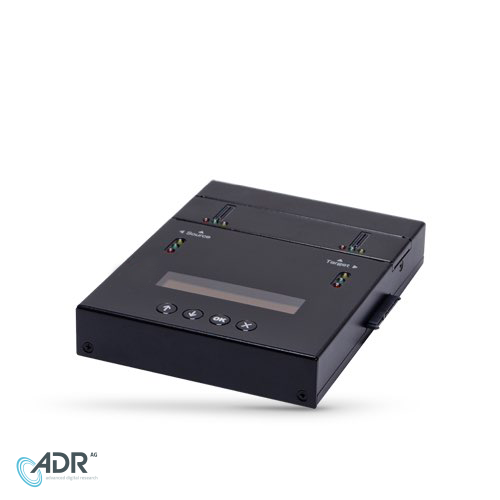


Discover the ADR1-1PCIE-PC-HS, a professional, high-speed data copying and erasure device that takes your data management to the next level.
Featuring a master port and a target port, this innovative copying device is equipped with an industrial FPGA architecture that offers platform-independent support, automatic signal identification, and an automatic shutdown function.
The Source Image File Management system enables centralized management of multiple image files on a hard drive with large storage capacity, making it significantly easier to organize and manage your data.
The Type-C interface enables seamless connection to a computer, making the ADR1-1PCIE-PC-HS an ideal external M.2 drive. This feature makes it easy to read and modify the contents of M.2 SSDs and contributes to more efficient data management.
Thanks to its platform-independent design, the ADR1-1PCIE-PC-HS enables direct copying without the need to install drivers or restart the system, regardless of the interfaces used by the connected devices.
When the device is connected to a computer via the Type-C interface, it can be used as an external drive for easily reading and editing the file contents on the source device.
Optimize your data management with the ADR1-1PCIE-PC-HS —a reliable solution for fast and efficient data copying and deletion.
| Transfer rate: | Up to 24 GB/min.* |
| Supported operating systems: | All—Windows, Mac, Linux, and other proprietary systems |
| Operating Mode: | Standalone, FPGA-based operation |
| LCD display: | 2 × 20-character, backlit monochrome LCD display |
| Compatible devices: | M.2 (NGFF) M-Key and B+M-Key, as well as SATA drives |
| Compatible signals: | NVMe, AHCI, SATA |
| Power supply: | 12 V, 5 A AC adapter |
| Operating temperature: | 5 °C–45 °C |
| Storage temperature: | –20 °C–85 °C |
| Operating humidity: | 20–80% |
| Storage humidity: | 5–95% |
| Dimensions: | 180 × 156 × 34 mm |
| Net weight: | 888 g |
| Gross weight: | 2,450 g |
| Packaging dimensions: | 340 × 280 × 190 mm |
*Actual performance depends on the transfer speed of the storage medium.